ITB Syndrome

Iliotibial Band Syndrome is pain at the outer part of the knee, thigh or hip. It is usually caused by overuse and it is often seen in runners. Other causes may be from excessive pronation of the foot, tight buttock muscles, poor running form, bowed legs or a leg length discrepancy. If you have pain at the outer part of your leg and it continues with daily activities and running, you need to consult a physical therapist.

Will Abdominal Crunches tone my Stomach?

Abdominal crunches only focus on your rectus abdominus (6-pack muscle). In addition to performing crunching exercises, you should focus on strengthening your core muscles. These muscles surround your rectus abdominus and connect to your back musculature. To truly tone your stomach muscles, you need to address more than your 6-pack.

An example of a good core strengthening exercise is to lie on your back and lift your knees to a 90/90 position. Lower one leg to tap your foot on the surface then bring the leg
back up. Alternate lowering each leg and tapping each foot on the surface.
Perform this exercise for 10 reps. Progress to 2 sets of 10, then 3 sets
of ten.
Check out the video below for a demonstration of this exercise by Dr. Amanda Macht
Lumbar Stabilization Exercise- Table Top Taps

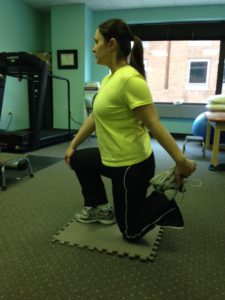
Do You Suffer From Calf Cramps?

Calf cramps come from tight muscle. The calf muscles can get tight from running, excessive walking, wearing high heels, and poor shoe support. If your calves are tight, begin a stretching program. In the following video, you will learn several ways to stretch your calves. Please note, you can hold the stretch for as little as 15 seconds for 2-3 repetitions to obtain results.

Calf Stretching Video

Toning Stomach Muscles

Most people perform various abdominal crunching exercises to achieve their goal of toning stomach muscles. Abdominal Crunches strengthen the rectus abdominis muscle (6-pack muscle) and the obliques. The muscle that most people neglect when toning their stomach is the transversus abdominis, also known as the core muscle. The transversus abdominis provides spinal stability and tones the sides of the torso (“the love handles”). Click here to watch a video to see how to perform the basic contraction of the transversus abdominis. To learn more stabilization exercises to strengthen the transversus abdominis, contact Harbor Physical Therapy.

Warm-up Ideas Before Exercise

Before you exercise, you need to perform a 5 minute warm-up to get the blood circulating to prepare your body for the activity. Depending on your form of exercise, it is always good practice to mimic your exercise activity at a lower intensity for a warm-up. Below is a list of warm-up activities.

– walk slowly for 3-5 minutes
– march in place for 5 minutes
– do 10-15 squats
– move your ankles in a circle and pump them up and down
– stand on one leg and swing the other back and forth
– move arms in circles in front of you and out to the side
– reach overhead several times
– put your arms out to your side and twist left and right

If you want a more aggressive warm up for running, you can perform jumping jacks, walk up and down stairs, or perform a fast pace walk to progress into a run.